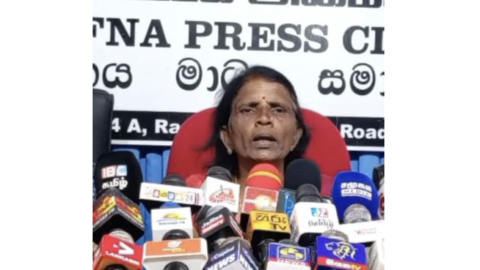
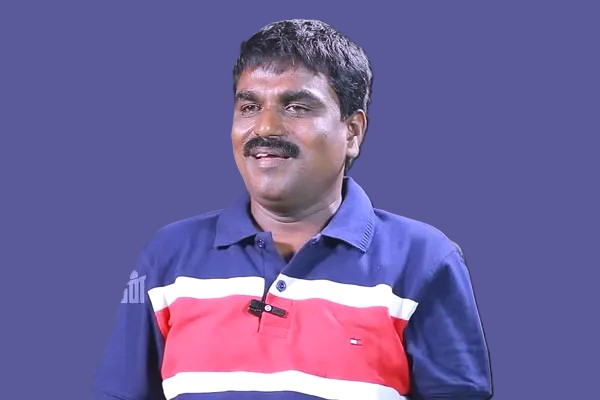
Human rights activist and political commentator Shan Master has strongly criticised the interim report submitted by Sri Lankan archaeologist Professor Raj Somadeva to the Jaffna court on the Semmani mass grave, alleging that it contains significant omissions and inconsistencies that could undermine efforts to establish the truth and deliver justice to the victims.
In a special statement, Shan Master described the approximately 170-page report as a “black report”, alleging that its findings could protect those responsible for the deaths and conceal crucial evidence. These are allegations made by the activist and have not been independently established.
Questions over the blue schoolbag
One of the key issues raised by Shan Master concerns a blue schoolbag reportedly recovered during excavations at the Semmani site. He said the discovery had received widespread coverage in print and electronic media and argued that the bag could provide important clues about the period in which the remains were buried.
According to Shan Master, similar schoolbags were distributed to schoolchildren by a non-governmental organisation during the period after 1995, amid the conflict. He questioned why the report did not adequately establish the bag’s date and significance.
He alleged that the omission of a clear assessment of the schoolbag represented a serious shortcoming in the investigation and called for a more comprehensive examination of the evidence.
Dispute over the cause and period of burial
Shan Master also questioned the report’s references to the possibility that the remains could be associated with infectious diseases or natural disasters.
He argued that there was no known hospital documentation supporting the suggestion that large numbers of people had died in Jaffna from such causes during the relevant period. He called for these possibilities to be examined against available medical, historical and documentary evidence.
He further criticised the report for not conclusively establishing when the victims were buried, arguing that the chronology was essential to determining the circumstances surrounding their deaths.
Questions over military control and past testimony
The activist pointed out that Semmani was under Sri Lankan military control during the war and in the period that followed, describing this as an important factor that investigators should consider when reconstructing the events.
He also referred to testimony attributed to former Sri Lankan Army Corporal Somaratne, who reportedly admitted in court to burying approximately 600 Tamil people in the area.
Shan Master questioned why the archaeological investigation had not, in his view, sufficiently addressed the significance of such testimony alongside the physical evidence recovered from the site.
He alleged that the report failed to adequately discuss the historical and security context of the area. The claims concerning the former soldier’s testimony and the report’s treatment of the evidence require verification against the relevant court records and the full report.
Concerns over the Hindu cemetery
Another issue raised in the statement concerns the Semmani Sindhubathi burial ground, which Shan Master said was registered as a Hindu cemetery under the Nallur Divisional Council.
He argued that the religious and cultural context of the site should have been adequately considered in the investigation. He also questioned the circumstances in which human remains were found in clusters, saying that the matter required a detailed forensic explanation.
Shan Master referred to a report by the Human Rights Commission of Sri Lanka following its visit to the Semmani mass grave. According to his account, the commission expressed concern about the arrangement of the skeletal remains and indicated that further investigation was necessary. He also said the commission had referred to the possibility of recommending foreign expertise if required.
He maintained that the concerns highlighted by the commission warranted further examination and questioned whether the interim report had adequately addressed them.
Criticism of Tamil political representatives
Shan Master also criticised Tamil political parties and representatives in the North and East, accusing them of failing to present a united response to the issues surrounding the Semmani investigation.
He questioned why Tamil political representatives had not collectively approached diplomatic missions to raise concerns about the interim report. He also accused sections of the Tamil political leadership of failing to prioritise the pursuit of justice for victims of mass atrocities.
The activist argued that the Semmani investigation should not be treated as an isolated issue, but as part of the wider struggle to establish accountability for alleged human rights violations and crimes committed against Tamil people during different periods of Sri Lanka’s history.
Call for Tamil forensic expertise
In his statement, Shan Master stressed the need for Tamil professionals and young people to develop expertise in forensic archaeology, forensic anthropology and mass grave investigations.
He argued that the lack of sufficient specialist capacity within the Tamil community had left investigations into matters of profound importance to Tamil people heavily dependent on experts appointed by the Sri Lankan state.
While acknowledging that the government might not appoint a Tamil specialist to lead such an investigation, he said the community should invest in developing its own scientific and technical expertise to scrutinise findings independently.
He emphasised that the struggle for justice required not only political representation but also professional knowledge and the ability to challenge investigative conclusions using scientific evidence.
“The struggle for justice for the Tamil people will not end with Mullivaikkal or Semmani,” Shan Master said in his statement, arguing that the pursuit of accountability must continue through both political engagement and the development of specialist knowledge.
He called on Tamil society to give greater attention to scientific expertise, independent scrutiny and collective action in the pursuit of truth and justice for the victims of the Semmani mass grave.
About The Author