Maitreyi Ramakrishnan Faces Sri Lankan Social Media Backlash
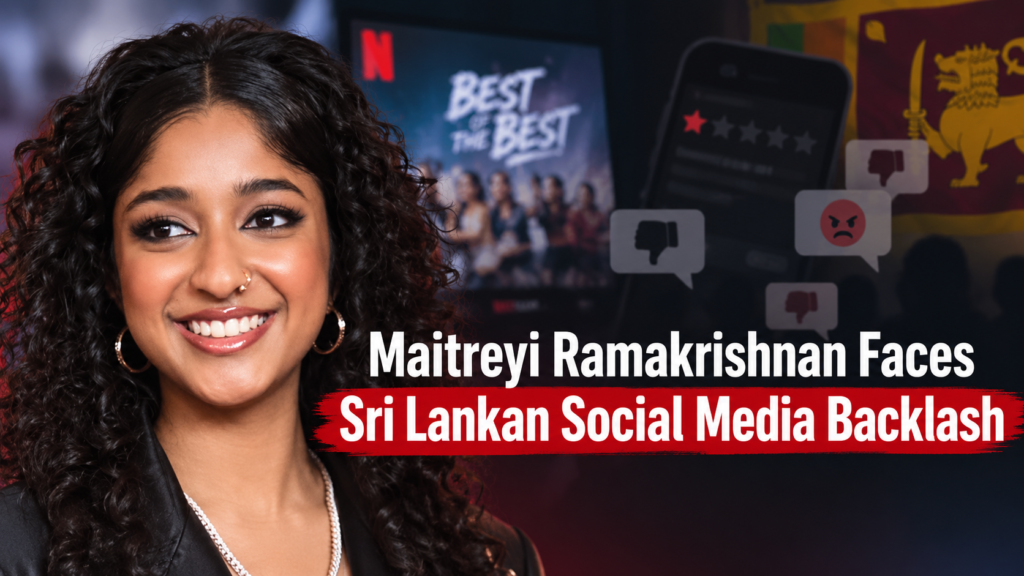
Colombo: Canadian actress of Sri Lankan Tamil heritage Maitreyi Ramakrishnan has faced a wave of criticism and abusive comments from some Sri Lankan social media users following the release of her new Netflix film Best of the Best.
The film, which premiered on Netflix on September 18, stars Ramakrishnan as Maya, a UCLA student who joins a competitive Bollywood-fusion dance team with her childhood friend. The coming-of-age comedy was written by Hasan Minhaj and Prashanth Venkataramanujam and directed by Lena Khan.
However, shortly after the film’s release, screenshots and reports circulated showing a large number of negative ratings for the movie from accounts identifying themselves as being from Sri Lanka.
According to a report by Jaffna Monitor, some Sinhala nationalist Facebook pages encouraged followers to give the movie one-star ratings on IMDb. The report also alleged that some posts portrayed Ramakrishnan as a supporter of the LTTE, while one page reportedly provided an artificial-intelligence prompt to help users create negative reviews of the film.
The same report said that, at the time its data was captured, around 90 percent of the Sri Lankan ratings recorded on IMDb were one-star ratings, with approximately 1,200 such ratings. The reported average among those Sri Lankan ratings was around 1.1 out of 10, while the movie’s overall IMDb rating was substantially higher.
The backlash appears to extend beyond criticism of the movie itself. Some social-media comments have focused on Ramakrishnan’s identity and her relationship with Sri Lanka. Other comments reportedly included personal and misogynistic attacks against the actress.
Why is Maitreyi being targeted?
Ramakrishnan was born in Canada to Sri Lankan Tamil parents who migrated to Canada. She became internationally known after playing Devi Vishwakumar in the Netflix series Never Have I Ever.
Her public identity and political views have previously generated controversy among some Sri Lankan social-media users. Critics have questioned her identification with her Sri Lankan Tamil heritage, while others have objected to her public comments and activism relating to political and human-rights issues.
These disagreements appear to have resurfaced following Best of the Best.
It is important, however, to distinguish criticism from racism or coordinated harassment. People can legitimately dislike a film, question its casting or criticise an actor’s public statements. But targeting an individual with racist, ethnic or misogynistic abuse, or attempting to manipulate a film’s rating because of the actor’s identity, is a different matter.
The controversy is bigger than Sri Lanka
Interestingly, criticism of Best of the Best has not been limited to Sri Lankan social media.
The film has also generated debate among some Indian audiences about Hollywood’s portrayal of South Asian culture and the casting of actors from different parts of the South Asian diaspora. Some criticism has focused on the film’s Bollywood-dance setting and whether its cast accurately represents the diversity of South Asia.
At the same time, several professional reviews have responded positively to the film’s portrayal of South Asian-American college life, friendship and Bollywood-fusion dance culture. The Guardian, for example, described the film as culturally rich while noting that it follows familiar college-comedy conventions.
Netflix describes Best of the Best as a story about friendship, sisterhood and self-acceptance, set within the competitive world of university Bollywood-fusion dance.
The controversy therefore raises a broader question: Can criticism of a public figure’s political views or identity remain legitimate criticism without turning into ethnic or personal abuse?
For Maitreyi Ramakrishnan, the release of Best of the Best has once again placed her Sri Lankan Tamil identity under the spotlight, this time not simply because of her acting, but because of the complicated relationship between celebrity, diaspora identity, Sri Lankan politics and social media.
Despite the backlash from some Sri Lankan social media users, Best of the Best has topped the charts in several countries. In Sri Lanka too, the film has reached No. 4.


About The Author