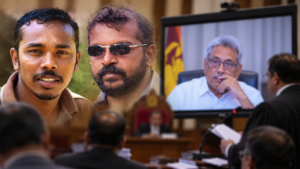
“I Don’t Remember” – Gotabaya Faces Tough Questions in Lalith-Kugan Disappearance Case
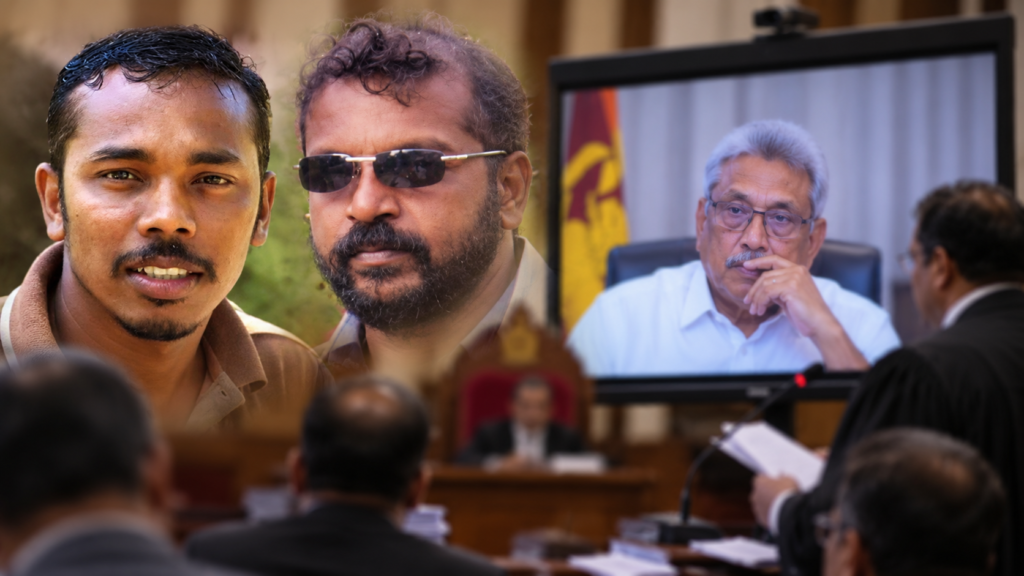
Former President and former Defence Ministry Secretary Gotabaya Rajapaksa appeared before the Colombo Chief Magistrate’s Court on September 29 and provided evidence via an online connection to the Jaffna Magistrate’s Court in the case concerning the disappearance of political activists Lalith Kumar Veeraraj and Kugan Muruganandan in 2011.
The case concerns the disappearance of Lalith Kumar Veeraraj and Kugan Muruganandan, who went missing in Jaffna on December 9, 2011. They were reportedly preparing activities connected to relatives of missing persons in the Avarangal area ahead of International Human Rights Day. Allegations presented in the case state that the two men were abducted by a group travelling in a white van.
Gotabaya Rajapaksa, who was Defence Secretary at the time, had previously been named as a witness in the case. After years of legal proceedings and repeated concerns raised over his appearance in Jaffna, the Jaffna Magistrate’s Court permitted him to provide evidence remotely. He was directed to appear physically at the Colombo Chief Magistrate’s Court and give evidence to the Jaffna court through an online connection.
According to the courtroom exchanges discussed on Satahan Radio, one of the most notable features of the evidence was Rajapaksa repeatedly saying that he could not remember details of several incidents because they had occurred around 15 years earlier.
Attorney-at-Law Nuwan Bopage, appearing for the complainants, questioned Rajapaksa about the circumstances surrounding disappearances and alleged abductions during the period when he served as Defence Secretary.
When questioned about whether the disappearance of civilians could constitute a national security concern, Rajapaksa said people disappear for various reasons and that such incidents are generally investigated by the police. He also stated that not every disappearance would necessarily be brought before the National Security Council.
The questioning also moved beyond the Lalith-Kugan case to the abduction of journalist Keith Noyahr.
Rajapaksa acknowledged that he remembered the Noyahr incident to some extent, but said he could not remember the details. When asked whether he remembered receiving a telephone call concerning Noyahr’s disappearance, he replied that he did not remember.
He was also questioned about whether he had informed senior police and security officials about the incident. On several occasions, Rajapaksa said he could not recall the specific details.
The former Defence Secretary was further questioned about the fact that members of the Army’s Tripoli Platoon had reportedly been arrested in connection with the Noyahr abduction. Rajapaksa said he was unaware of this.
Bopage also put to Rajapaksa the suggestion that Noyahr had ultimately been released because of his intervention. Rajapaksa strongly rejected that allegation.
He also rejected allegations that he had personally instructed or intervened in abductions and enforced disappearances during his tenure as Defence Secretary.
Rajapaksa told the court that he was not involved in ground operations and that his responsibility as Defence Secretary was to communicate government policy to relevant institutions. He said he had never issued instructions concerning abductions or disappearances and did not have such authority.
When questioned about allegations linking security forces and intelligence agencies to disappearances, Rajapaksa described such allegations as politically motivated claims intended to damage Sri Lanka’s reputation and obtain political advantage.
Another important issue raised during the proceedings was a previous statement by then government spokesman Keheliya Rambukwella concerning Lalith and Kugan. Rambukwella had publicly stated at the time that the two men were alive, and during subsequent proceedings it was reported that he had said the information was based on information provided by the then Defence Secretary Gotabaya Rajapaksa.
This issue has remained significant in the case because it forms part of the circumstances under which Rajapaksa was eventually called as a witness.
The testimony was not completed during the September 29 hearing. The Jaffna Magistrate’s Court has fixed November 27 for the continuation of the recording of evidence, with Rajapaksa ordered to appear again.
The appearance of a former President before court as a witness in a case concerning two people who disappeared during his tenure as Defence Secretary has attracted considerable attention.
As discussed by Tharindu Uduwaragedara and Bazeer on Satahan Radio, the significance of the hearing extends beyond the individual Lalith-Kugan case, as the proceedings have become closely associated with the broader issue of alleged abductions, enforced disappearances and accountability in Sri Lanka.
However, the allegations raised during the proceedings remain allegations, and the court has not made a final determination establishing responsibility for the disappearance of Lalith Kumar Weeraraj and Kugan Muruganandan.
This report is based on the discussion by journalists Tharindu Uduwaragedara and Bazeer on the Satahan Radio YouTube channel, together with details reported from the court proceedings. The discussion examined what took place inside the courtroom when former President and former Defence Secretary Gotabaya Rajapaksa gave evidence remotely in the long-running Lalith-Kugan disappearance case.
Full Video
About The Author