The Sri Lankan Passport and Sri Lanka’s Open Door: Two Very Different Stories of Global Travel

The Sri Lankan passport offers relatively limited global mobility, particularly when compared with passports from countries in Europe, North America and some parts of Asia. Yet Sri Lanka has a comparatively accessible system for many foreign tourists. This contrast reveals much about tourism, diplomacy, regional relationships and the unequal geography of modern passports.
A passport is a document of mobility, but mobility depends very much on which direction you are travelling.
For Sri Lankan citizens, travelling abroad can involve visas, supporting documents, financial evidence, hotel bookings, travel histories and advance planning. For many foreigners coming to Sri Lanka, the process can be considerably simpler.
Sri Lanka operates an Electronic Travel Authorization (ETA) system, while citizens of 40 countries are currently eligible for tourist visas free of charge for stays of up to 30 days. Citizens of Singapore and Seychelles can also receive 30-day tourist visas free of charge under bilateral arrangements, while Maldivian citizens can receive a 90-day tourist visa free of charge.
So, how easy is it to enter Sri Lanka compared with how easy it is for a Sri Lankan passport holder to travel abroad?
The answer reveals an interesting feature of modern international travel. Sri Lanka’s passport may have limited global reach, but Sri Lanka itself is relatively accessible to many international visitors.
The Sri Lankan passport remains limited
The Henley Passport Index measures passports according to the number of destinations their holders can access without obtaining a visa in advance. Its 2026 index covers 199 passports and 227 destinations and is updated regularly as visa policies change.
Sri Lanka is currently ranked 94th in the 2026 Henley Passport Index, with access to 39 destinations without a prior visa under the index’s methodology.
That puts Sri Lankan citizens in a very different position from citizens of countries whose passports provide access to a large majority of the world’s destinations.
For Sri Lankan travellers, regional destinations can be considerably easier than long-distance travel. Depending on the destination and the current rules, Sri Lankan passport holders may have access through visa-free arrangements, visas on arrival or electronic travel authorizations.
But the picture changes significantly when travelling to major destinations in Western Europe, North America and some other developed economies.
A holiday in the Maldives or Nepal can involve considerably less preparation than a holiday in countries such as the United States, Canada, Australia or the Schengen Area, where Sri Lankan citizens generally need to obtain the relevant visa or authorization before travelling.
A short regional trip and a long-distance holiday can therefore represent two very different levels of paperwork for a Sri Lankan passport holder.
Sri Lanka is easier for many foreigners to enter
Now turn the passport around.
Sri Lanka’s immigration system provides several routes for foreign tourists, including ETA-based travel and visa arrangements for specific nationalities.
As of May 25, 2026, citizens of 40 countries can obtain a tourist ETA free of charge for 30 days. The list includes Australia, Austria, Bahrain, Belarus, Belgium, Canada, China, the Czech Republic, Denmark, Finland, France, Germany, India, Indonesia, Iran, Israel, Italy, Japan, Kazakhstan, Kuwait, Malaysia, Nepal, the Netherlands, New Zealand, Norway, Oman, Pakistan, Poland, Qatar, Russia, Saudi Arabia, South Korea, Spain, Sweden, Switzerland, Thailand, Türkiye, the United Arab Emirates, the United Kingdom and the United States.
Sri Lanka also has bilateral arrangements providing free tourist visas for citizens of Singapore and Seychelles for up to 30 days and for Maldivian citizens for up to 90 days.
Importantly, the current system does not simply mean that these travellers can arrive without doing anything. The Department of Immigration states that foreign nationals covered by these arrangements still need to obtain the relevant ETA before arrival.
For many other nationalities, Sri Lanka continues to operate its general ETA and visa arrangements, with applicable fees depending on nationality and visa type.
In other words, Sri Lanka has not removed immigration controls. Instead, it has increasingly moved much of the process online.
The paperwork has not disappeared. It has simply learned to use Wi-Fi.
South Asia makes the contrast particularly interesting
The contrast becomes especially visible when Sri Lanka is viewed from its own region.
Sri Lanka sits in the Indian Ocean between South Asia and Southeast Asia, with India and the Maldives among its most important regional travel connections.
Sri Lankan citizens can travel to some nearby countries through relatively convenient arrangements, while Sri Lanka itself has introduced simplified or free tourist-visa arrangements for several major visitor markets.
India is particularly significant. Indian nationals are included among the 40 countries eligible for the current 30-day free tourist ETA arrangement in Sri Lanka.
This demonstrates how bilateral relations and tourism policy can influence the practical experience of crossing borders.
A passport ranking therefore does not tell the whole story.
A Sri Lankan passport may have limited access on the global scale, while Sri Lanka’s location, tourism industry and diplomatic relationships can make the country relatively accessible to international visitors.
Visa-free does not mean “no rules”
There is an important detail travellers should never overlook.
Visa-free travel, a free ETA and an ordinary visa are not necessarily the same thing.
Even travellers who qualify for Sri Lanka’s free tourist ETA must satisfy the country’s entry requirements. The official ETA system states that travellers should be able to demonstrate a return or onward ticket when travelling by air and sufficient funds to cover their stay. An ETA also does not automatically guarantee admission at the port of entry.
The length of stay can also vary according to nationality and the applicable arrangement.
This is why travellers should always check the latest requirements through Sri Lanka’s official immigration or ETA websites before travelling.
Visa rules have a habit of changing at precisely the moment someone has already booked the non-refundable ticket.
Why are the two sides so different?
There is no single reason why Sri Lanka can make entry relatively convenient for many foreign tourists while Sri Lankan citizens face substantial visa requirements in many countries.
Visa policies reflect a combination of tourism policy, diplomacy, security concerns, migration policy, economic interests and bilateral agreements.
For Sri Lanka, tourism is an important part of the economy. Simplifying entry for visitors from major tourist markets can therefore have an obvious economic purpose.
At the same time, other countries may impose stricter visa requirements on Sri Lankan citizens because of their own immigration, security and migration policies.
This is why a country’s passport strength and its openness to foreign visitors should not be confused.
They are two different measures.
The first asks:
Where can our citizens go?
The second asks:
Who can come here, and under what conditions?
Sri Lanka can give very different answers to those two questions.
The map can change
Passport mobility is not fixed forever.
Countries negotiate visa-waiver agreements, introduce electronic travel systems, change visa fees and establish temporary or permanent exemptions.
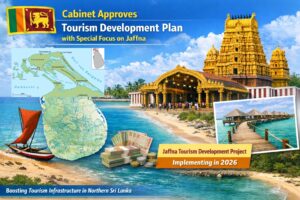
The Sri Lankan government’s decision in 2026 to provide free tourist visas for citizens of 40 countries is a good example of how quickly the practical experience of entering a country can change.
The Henley Passport Index itself is updated monthly because visa policies can change over time.
A passport ranking should therefore be understood as a snapshot of international mobility rather than a permanent description of a country’s diplomatic position.
What this means for Sri Lankan travellers
For Sri Lankan citizens, the sensible approach is to check the specific destination rather than relying only on a passport ranking.
Before booking a trip, determine whether the destination is:
- visa-free;
- visa on arrival;
- accessible through an ETA;
- accessible through an e-Visa; or
- subject to a conventional visa application before departure.
The distinction matters because an e-Visa generally requires approval before departure, whereas visa-on-arrival arrangements do not require that same advance approval. Henley & Partners uses these distinctions in its passport methodology.
For Sri Lankan citizens planning international travel, the destination country’s embassy or official immigration authority should always be treated as the final source of current visa requirements.
For foreign travellers coming to Sri Lanka, the official Sri Lankan ETA system provides the current application and eligibility information.
Conclusion
The Sri Lankan passport and Sri Lanka’s immigration policy tell two very different stories.
Sri Lankan citizens still face significant visa barriers when travelling to many major destinations, particularly in Europe, North America and some other long-distance markets.
At the same time, Sri Lanka has made entry comparatively straightforward for visitors from a wide range of countries, including through its 2026 free-tourist-visa arrangements for citizens of 40 countries.
The contrast is a useful reminder that passport strength and a country’s openness to foreign visitors are not the same thing.
One describes how easily citizens can leave.
The other describes how easily visitors can come in.
For Sri Lanka, those two maps look very different.
And in an increasingly connected world, understanding both maps may be more useful than looking at a passport ranking alone.
About The Author